
The Hitachi Amino Acid Analyzer is a high-performance laboratory instrument designed to analyze and quantify amino acids in various samples.
Developed with the user in mind, the AminoSAAYA offers easy and comfortable operability while maintaining the reliability and stability of Hitachi’s legacy amino acid analyzers.
Ergonomic Design
Designed from the perspective of the user, the AminoSAAYA’s daily workflow, movements, and operational requirements are extremely simplified.
The height of the reagent setup unit accommodates better accessibility.
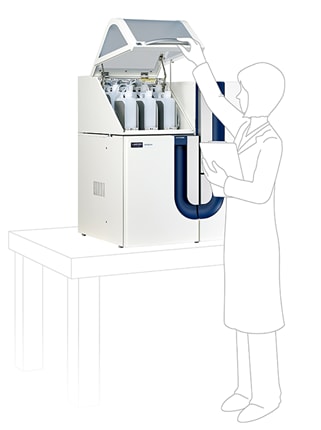
Space-saving compact design
This new design resulted in a unit with a footprint that is 30% less than the previous models.
The use of Hitachi’s highly reliable and stable post-column Ninhydrin method ensures compatibility with methods run on previous models (L-8800/L-8900).
Select the analysis method (column, reagent, and analytical conditions) depending on your required analysis (Protein Hydrolysates (PH) or Physiological Fluids (PF)).
Unstable Ninhydrin reagents usually require refrigeration. However, with the Hitachi amino acid analyzer, the two solutions are mixed immediately before the derivatization reaction. Therefore, there is no need for refrigeration.
Data
Analysis Example: STANDARD ANALYSIS COLUMN (Protein Hydrolysate analysis method)
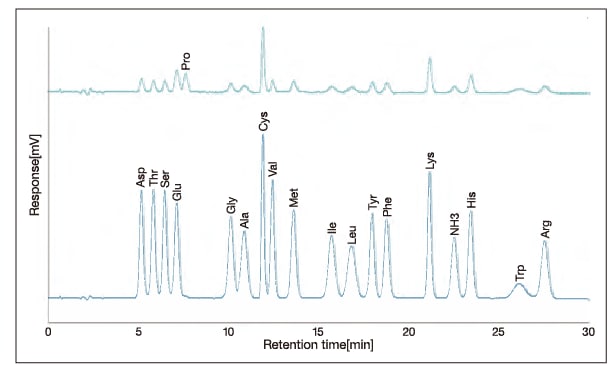
System performance (by protein hydrolysate analysis method)
| Analysis time | Approx. 30 minutes (Net) |
|---|---|
| Resolution | Thr-Ser、Gly-Ala、Ile-leu, more than 1.2 |
| Reproductively of the peak retention time | RSD 0.5% or less (Ala peak) RSD 0.3% or less (Arg peak) |
| Reproductively of the peak area | RSD 1.0% or less (Gly, His peak) |
| Detection limit | 2.5 pmol (S/N = 2 at Asp peak) |
System performance (by physiological fluid analysis method)
| Analysis time | Approx. 110 minutes (Net) |
|---|---|
| Resolution | Thr-Ser、Gly-Ala、Ile-leu, more than 1.2 |
| Reproductively of the peak retention time | RSD 0.5% or less (Ala peak) RSD 0.3% or less (Arg peak) |
| Reproductively of the peak area | RSD 1.5% or less (Gly, His peak) |
| Detection limit | 8pmol(S/N = 2 at Asp peak) |
Analyzer
| Column | Size: 4.6 mm ID × 60 mm * |
|---|---|
| Resin: Hitachi custom ion exchange resin | |
| Pump | Flow rate setting range: 0.001-1.000 mL/min |
| Discharge pressure: 0 – 34 MPa | |
| Gradient elution method with 6 solutions | |
| Autosampler | Injection method: Direct injection method |
| Sample vial capacity: 1,500 µL | |
| No. of vials accommodated:120(with optional cooling unit installed: 100) | |
| Sample injection volume: 0.5 – 100 µL | |
| Column oven | System: Peltier |
| Temperature setting: 20 – 90 °C (in 1 °C steps) | |
| Reaction unit | System: Electronic heating |
| Temperature setting: 50 – 140 °C (in 1 °C steps) | |
| Detector | Spectrophotometer: Aberration-corrected |
| concave diffraction grating | |
| Wavelength: 570 nm, 440 nm |
Others
| Dimensions (excluding PC) | 700 (W) × 600 (D) × 850 (H) mm |
|---|---|
| Temperature range | 15 – 35 °C |
| Power supply | 100, 115, 220, 230, 240 V ± 10 V, 800 VA, 50 or 60 Hz |
| Nitrogen gas | Nitrogen gas source must be prepared. |
*Standard column

